Why your business has sales but no cash
It is one of the most disorienting feelings in business: the tills are busy, the sales look healthy, and yet the bank account is tight and payday is a worry. You are not imagining it, and you are not necessarily doing anything wrong. Sales, profit and cash are three different things, and the gap between them is where most owner stress lives. Here is where the money actually goes, and how to see it in your own numbers rather than guess.
Sales are not the same as cash
Three numbers get treated as one, and they are not. Sales is what customers agreed to pay. Profit is what is left after costs, on paper. Cash is what is actually in the bank, today, that you can spend. A month can be strong on the first two and painful on the third, because sales and profit are recorded when a deal is done, while cash only exists when the money has genuinely arrived and the bills it owes have not yet left.
That timing gap is the whole story. A busy month can *increase* your cash pressure rather than ease it: more sales can mean more stock bought up front, more supplier bills, more wages, and more tax owed, all landing before the customers behind those sales have paid. Growth eats cash. That is normal, and it is survivable once you can see it coming.
The five places cash disappears
When sales are up but cash is not, the money is almost always sitting in one of these:
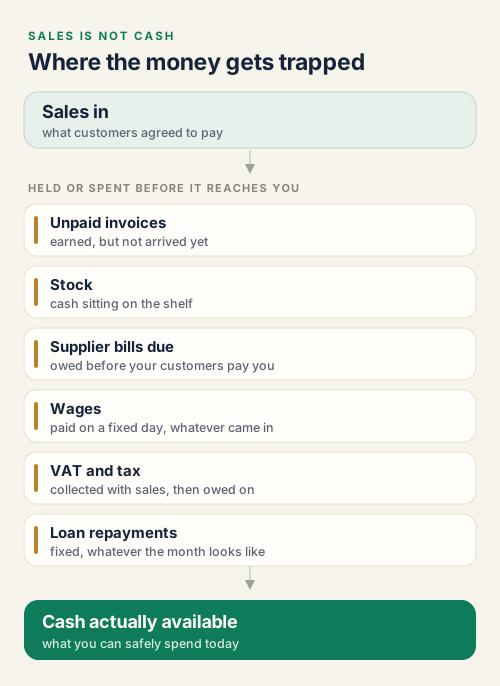
- Unpaid invoices. Work you have done and billed, but not been paid for. On paper it is revenue; in the bank it is nothing yet. The longer customers take, the more of your cash they are quietly holding.
- Stock. Every item on the shelf is cash you have already spent and not yet sold. A well-stocked shop can be cash-poor precisely because the cash is in the stockroom.
- Bills due before the cash arrives. Suppliers, rent and wages run on their own timetable, usually before your customers pay you. If you pay in 30 days but get paid in 60, you fund the gap.
- Money that was never really yours. VAT and other taxes are collected with your sales and sit in your account until they are owed on. A healthy-looking balance can already be spoken for.
- Fixed outgoings that ignore your month. Loan and finance repayments, and refunds or chargebacks, come out whether the month was strong or weak. Seasonality makes this worse: a quiet stretch still carries the same fixed load.
The diagram below shows the same idea as a flow: what comes in at the top, and everything that holds or spends it before it reaches the bottom.
Why looking only at the bank balance misleads you
The bank balance is the number every owner checks, and on its own it lies in both directions. A comfortable balance can already be committed to a VAT bill, a supplier run and next week's wages, so it is smaller than it looks. A frightening balance on a Monday can be fine by Friday once a big invoice clears. The balance tells you the level of the water; it tells you nothing about the taps still running in and out.
What actually keeps you safe is the *shape* of the money over the next few weeks: what is coming in and roughly when, against what must go out and when. A single number today cannot show timing, and timing is the entire problem. This is the difference between a snapshot and a cash-flow view, covered in depth in how to read your business cash flow.
What Xero or QuickBooks can reveal
Your accounts hold the two sides of the timing gap. They show your unpaid invoices (what you are owed, and how overdue it is) and your unpaid bills (what you owe, and when it falls due). Read together, those two lists are most of the answer to "where is my cash". They also show recorded profit, so you can see when a busy month is not actually a profitable one.
Xero and QuickBooks are where this lives. If your books are current, the overdue-invoice list alone often points straight at the cash that is stuck. If they are not current, the picture is unreliable, which is why clean, provable books are the foundation for trusting any of this.
What Square or till data can reveal
Your till or point-of-sale shows the other half: what is genuinely selling, day by day, and what is not. It tells you whether takings are actually up or just feel busy, which days and lines carry the month, and where discounting is quietly eroding what each sale is worth. A busy-but-tight month often turns out to be strong volume on thin margin, which sells effort but not much cash.
Square, Lightspeed Retail (X-Series) and other till systems capture this. Read next to the accounts, real takings versus recorded revenue is where a lot of "we were rushed off our feet and still made nothing" gets explained, and it ties directly to your gross margin.
What bank or Open Banking data adds
Your accounts say what *should* have happened; your bank says what *did*. Connecting the bank (through Open Banking, read-only) shows the real balance and the real timing of money in and out, so you can catch cash leaving that the books have not recorded, income that has not landed when it should have, and the true low points between now and payday. It is the difference between a plan and reality, and it is what turns "I think we are alright" into "I can see we are". You can set this up from the integrations page.
The owner questions to ask every week
You do not need a finance degree, you need a short, honest weekly look. Five questions surface most cash trouble before it bites:
- Who owes me, and how overdue is it? The oldest and largest unpaid invoices first.
- What must I pay in the next two to three weeks, and when exactly? Wages, suppliers, rent, tax.
- What is my real low point before the next money reliably arrives? Not today's balance, the dip.
- Is a busy week actually turning into cash, or just into stock and effort?
- What is the one thing I can do this week to ease the tightest point? Chase an invoice, delay a non-urgent order, agree terms.
Working through these is the habit; the numbers worth watching every week and improving margin without chasing growth you cannot afford are the natural next steps once you can see the pattern. Our free break-even calculator is a quick way to sanity-check how much you need to cover the fixed load each month.
How Moonmoot turns this into one clear next action
Moonmoot does not magically fix cash, and it will never pretend to. What it does is remove the guesswork. It connects your accounting, your till, your bank and your operational signals into one picture, so instead of five tabs and a gut feeling you get a plain-English read of *where the pressure is actually coming from* this week, and the single clearest move to ease it. When more than one source touches the same money, it cross-checks them and names the gap rather than guessing, and when a number is not connected it says so instead of inventing one.
That is the point of a busy-but-tight month: the cash is somewhere, and it is usually recoverable once you can see where. The fastest way to find out on your own numbers is a free instant read: an honest picture of your business, no card and no signup for the read. If cash discipline is something you are building toward a sale or investment, it is also one of the biggest levers on what your business is worth.