How to use business documents as evidence for better owner decisions
Most owner-operated businesses carry their real evidence in scattered files: a lease PDF, a stack of supplier contracts, a loan agreement, payroll exports, compliance certificates, a folder of notes only you can decode. Your numbers tell you what happened. Those documents often explain why. Here is how to turn the paperwork you already have into context that leads to better decisions, and how Moonmoot uses only the documents you choose.
Numbers tell you what happened. Documents tell you why
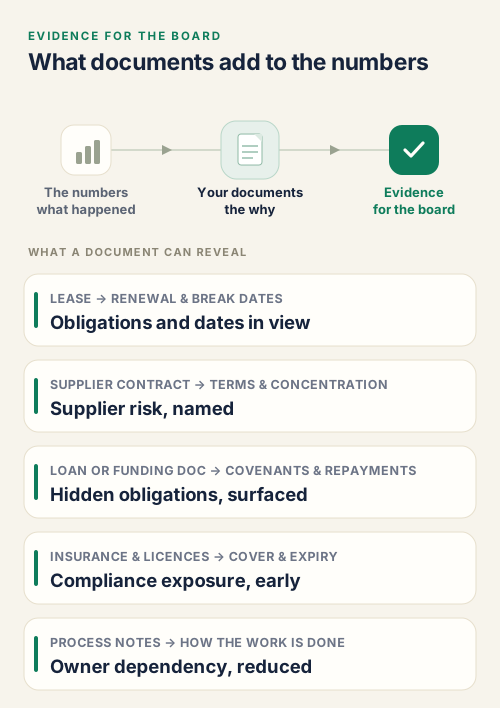
Your accounts, till and bank show you the what: revenue dipped, a cost line crept up, cash is tighter than last quarter. What they rarely show is why. A margin that quietly eroded might be a supplier contract that repriced on a renewal date buried in a PDF. A cash squeeze three months out might be a loan covenant nobody reread. A compliance risk might be a licence that lapsed while everyone was busy.
Documents are where the why usually lives. On their own, numbers invite guessing. Paired with the paperwork behind them, they let you reason from evidence instead. That is the whole point of treating your documents as a first-class input, not a drawer you open only when something goes wrong.
The documents that change the board's understanding
You do not need to digitise everything. A handful of documents carry most of the context that numbers miss:
- Leases and property agreements. The single largest fixed commitment most local businesses have, with dates and clauses that decide your room to manoeuvre.
- Supplier and customer contracts. The terms behind your costs and your revenue: pricing, notice periods, exclusivity, minimum volumes.
- Loan, finance and funding documents. What you owe, when, and under what conditions, including covenants that can quietly constrain the business.
- Payroll and staff documents. Contracts, key-person arrangements and obligations that sit behind your biggest recurring cost.
- Compliance evidence. Licences, certifications, insurance policies and inspection records: proof of what you are permitted to do and until when.
- Internal process notes. How the work actually gets done, which is often the difference between a business and a job that only you can do.
What documents can reveal
Read as evidence rather than filed and forgotten, these documents surface the things that quietly decide a year:
- Hidden obligations. Covenants, guarantees, minimum spends and auto-renewals that never show up in the numbers until they bite.
- Renewal and expiry dates. Lease breaks, rent reviews, licence and insurance renewals: dates that are cheap to act on early and expensive to miss.
- Supplier and customer risk. Concentration in one supplier or client, and the terms that make leaving costly.
- Cost drivers. The contractual reasons a cost line moves, so a rise is explained rather than merely noticed.
- Owner dependency. How much of the business lives only in your head, which is the quiet sale-killer and the thing process notes start to fix.
- Compliance exposure. Gaps between what you are required to hold and what you can actually prove.
How Moonmoot uses the documents you choose
Moonmoot treats documents as its evidence layer, and it is deliberately careful about access. A few things are worth being precise about:
- You choose what to share. During onboarding you connect Google Drive and pick the specific files or folders Moonmoot may read, through Google's own file picker. It reads only what you pick. It does not read your whole Drive, and it does not automatically watch folders for files you add later.
- Read-only. Moonmoot reads the text of the documents you shared to use as evidence. It never edits, moves, renames or deletes anything in your Drive. The full detail lives on the Google Drive integration page.
- Documents become evidence, not assertions. When the board relies on a document, it can tie a conclusion back to the file behind it, flag dates like renewals and expiries, and be honest about what it still cannot see. Where something you have said is not backed by a document, it names the gap rather than taking the claim as proof.
- Evidence sits alongside your live systems. The strongest picture comes from documents read together with your accounting, till and analytics. A shared bank statement, for instance, is evidence for its period, not a live bank feed. Documents add context; they do not replace the connected systems that supply your business numbers.
That last point matters. Paperwork is where the why lives, but your accounts and till are where the current numbers live. Used together, a busy month that is not a profitable month, or a cost that rose for a contractual reason, gets explained instead of guessed at.
What not to share
Sharing more is not better. Keep it to documents that are genuinely about the business:
- Personal or family files, photos, and anything unrelated to how the business runs.
- Documents that belong to someone else, or that you are not comfortable sharing.
- Duplicates and drafts where a single current version will do.
If a document would not help someone understand or value the business, it does not need to be in the set. You can add or remove what you share at any time.
A simple starting set
If you want the board working from real evidence quickly, prepare five to ten documents before onboarding. A sensible starting set for most owner-operated businesses:
- Your current lease or premises agreement.
- Your main supplier contracts, especially any with minimum volumes or long notice.
- Any loan or finance agreement currently in place.
- Your insurance policies and any licences or certifications you rely on.
- A recent bank statement or two as documentary evidence.
- Any key customer contracts where the terms matter.
- A short process note on anything that currently only works because you do it.
That set alone moves a lot of the board's understanding from assumption to evidence. It is also, not by coincidence, close to what a lender or a buyer's due diligence would ask to see, which is why getting it in order early pays off well beyond the day-to-day. If you are thinking about value at all, the exit readiness score shows which gaps are capping the price today, and clean, provable records are a recurring theme in what actually makes a business worth more.
Where to start
If your evidence is scattered across PDFs and folders, the win is not tidiness for its own sake, it is decisions made from context instead of guesswork. Pull together the starting set above, see how Moonmoot reads the documents you choose on the Google Drive integration page, and get an honest first read of your business with a free instant read. Keeping your books provable at the same time is covered in clean books for a small business.