AI Makes You Faster. It Does Not Build the Business Around You
AI has handed founders more leverage than any tool in a generation, and that is genuinely good. But leverage points wherever you aim it, and the easiest place to aim it is at more of your own work. This is about the trap hiding inside AI's gift, and the better way to spend what it frees up.
AI has made the solo-founder trap more seductive
For the first time, one person with the right tools can draft the marketing, answer the emails, write the proposal, reconcile the books and sketch the strategy, all before lunch. It feels like a superpower, and in a real sense it is. The trouble is what it tempts you to do with it. The instinct is to take the hours AI gives back and pour them into more tasks, more output, more things only you touch. That does not feel like a trap. It feels like momentum. But doing more of the business yourself, faster, is the oldest ceiling there is wearing a new and very convincing disguise.
None of this is a knock on founders. The pull to do it yourself is the same instinct that got the business off the ground, and AI has made that instinct cheaper to indulge than ever. That is exactly why it is worth naming.
Doing everything faster is not the same as building a better business
Speed and progress feel identical from the inside, and they are not the same thing. Clearing your inbox at twice the pace, shipping twice the content, handling twice the admin: all of it can leave the business exactly as dependent on you as it was, only busier. You have optimised the treadmill, not stepped off it.
The question AI does not answer for you is which work should exist at all, and which of it should ever run through you. A faster version of the wrong setup is still the wrong setup. The businesses that pull ahead use the freed time to change the shape of the business, not just its speed.
The richest businesses are built through people, trust and distribution
Look at how durable value actually gets built and it is rarely one brilliant person in a room. It is networks, trust and access. It is the partner who opens a channel you could not reach alone, the reputation that makes the next deal easier, the capable people who carry parts of the business you used to hold, the distribution that puts your work in front of people who were never going to find you on their own.
None of those are things you can do faster by yourself. They are things you build with and through other people, over time, on the back of relationships. AI can help you prepare for them, but it cannot have the conversation, earn the trust or be the relationship. That part is still stubbornly, and valuably, human.
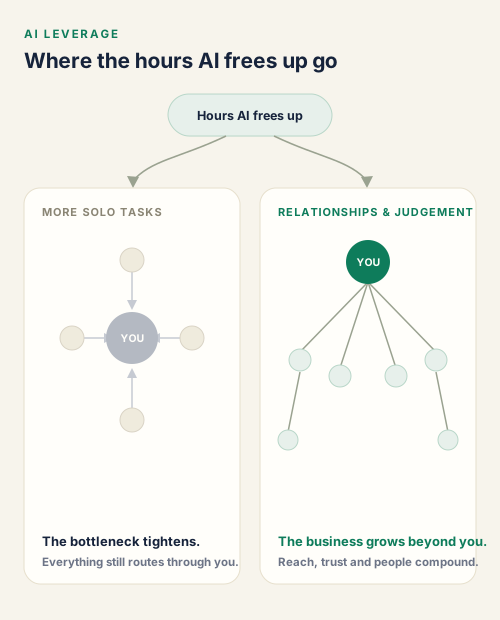
Why working in the business still caps value, even with AI
Here is the part that matters if you ever want the business to be worth something beyond your own effort. A business whose engine is one founder, however AI-augmented, is still a business that stops when the founder does. Buyers, lenders and partners can all see it, and they price it accordingly: heavy dependence on one person is one of the biggest discounts on enterprise value there is, and a large part of why so many owner-run businesses never sell.
AI does not change that arithmetic, it sharpens it. It lets a solo founder run further on their own, which can disguise the dependence for longer while quietly making it worse underneath. A business that leans less on any one person, that runs on transferable relationships and systems, is worth more, and AI used well should be moving you towards that, not away from it. Lowering owner dependence is the whole game, and the operational side of it is in make your business run without you.
The better use of AI: create space for relationships and judgement
So here is the reframe. The point of AI is not to let you do more of the work. It is to hand back the hours you were spending on work that never needed your judgement, so you can spend them on the things that genuinely do: the relationships, the partnerships, the hiring, the decisions that set direction.
Let AI take the first draft, the reconciliation, the routine reply, the research. Then deliberately reinvest what it frees, not into more tasks, but into the few things that only you can do and that actually compound: being in the rooms that matter, building the relationships that open doors, thinking clearly about where the business is going. Used that way, AI is not a way to work more alone. It is a way to buy back the time to stop having to.
Partnerships, incentives and leadership still matter
Freed time only helps if you spend it building the things that let the business outgrow you: capable people with real responsibility, partnerships that give you reach you cannot build alone, and incentives that make good people act like owners. That is its own subject, and the mechanics of sharing responsibility and, where it fits, ownership are covered in how ownership, incentives and culture help a business grow past you. The short version: AI can make you a more effective leader, but it cannot be the leadership. The team, the trust and the terms are still yours to build.
What Moonmoot believes: AI should reduce owner dependence, not reinforce it
This is the whole reason Moonmoot exists, so it is worth being plain about it. We are not sceptical of AI; we are built on it. What we are against is AI that just turns a founder into a faster bottleneck. Pointed at the wrong problem, AI helps you bury yourself deeper in tasks. Pointed at the right one, it helps you see the business clearly, decide better, and free yourself from being in every seat.
That is the version we build for: AI that reads your real numbers, shows you where the business is leaning too hard on you, where margin is slipping and what the next decision should be, so your attention goes to the few things that actually move it. This is also why an AI board on your own numbers is a different thing from a chatbot doing your tasks, which we cover in using ChatGPT versus an AI board. The measure of good AI for an owner is not how much more you can do alone. It is how much less the business needs you to.
A practical owner's checklist
None of this is abstract. This week, pick one from each:
- Stop doing one recurring task that does not need your judgement, and hand it to a tool or a person. The test is simple: if a capable stand-in with the right instructions could do it, it should not be you.
- Delegate one thing you have held onto out of habit rather than necessity, and let someone own the outcome, not just the task.
- Involve one capable person in a decision you would normally make alone, so judgement starts to live in more than one head.
- Build one relationship this month you have been "too busy" for: a partner, a mentor, a supplier, a peer. Put it in the diary before the week fills up.
Then use the business valuation calculator as an honest mirror: it will show you, roughly, how much the business currently leans on you, and give you a number to move. AI can hand you the hours. What you build with them is still the whole job.