You Are the Ceiling: How Ownership, Incentives and Culture Help a Business Grow Past You
Every owner-operated business has a ceiling, and for a long time it is the owner. That is not a criticism; your judgement and relationships are why it works. It becomes the problem only when everything still runs through you, and the business can grow no larger than one person can reach. This is about how ownership, incentives and, most of all, culture let a business grow past its founder, and the traps to avoid on the way.
The business cannot grow past the owner's ceiling
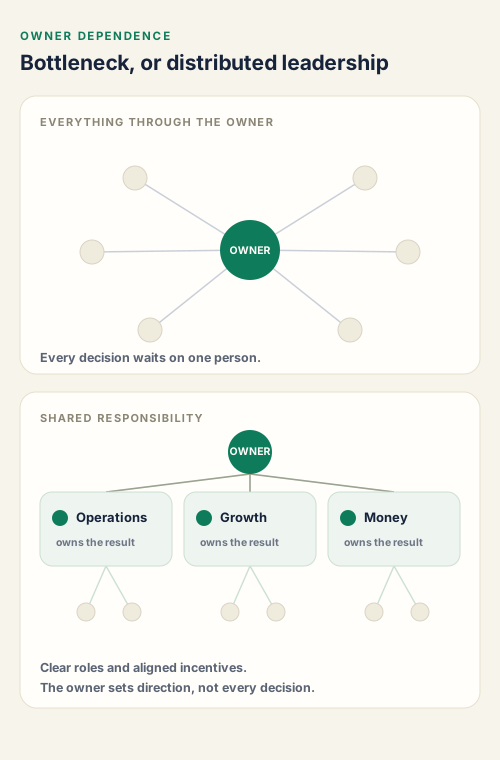
Every owner-operated business has a ceiling, and for a long time it is the owner. There is nothing wrong with that at the start: your judgement, your standards and your relationships are exactly why the business works. The problem comes later, when the same instinct that built the business quietly caps it. If every decision, every standard and every relationship still runs through you, the business can only ever be as big as one person's time, attention and energy. You become the ceiling, and no amount of effort raises a ceiling made of yourself.
It rarely feels like that from the inside. It feels like being busy, needed and on top of things. But being needed for everything is not the same as building something that lasts, and over time the two pull in opposite directions.
Why good people leave when everything revolves around the owner
Here is the pattern that costs the most and shows up least on any report. When every decision needs the owner's sign-off, the people with the most potential feel it first. Capable people want responsibility and room to act; if they cannot get it, they go somewhere they can. What tends to stay is not disloyal or less able, but it learns that the job is to keep the owner happy rather than to move the business forward.
Over time that quietly selects for orbit rather than initiative, and the owner concludes "I can't find good people" or "if you want it done properly, do it yourself", which tightens the very loop that pushed the good ones out. The turnover barely registers as a number, but you feel it as a business that always needs you and never quite grows. What that churn really costs is set out in hiring and keeping good people.
What bigger companies understand about incentives
Larger companies are not better because they have more rules. They are better at one specific thing: getting capable people to act like owners without being the owner. They do it by handing over real responsibility, being clear about what good looks like, and aligning what is good for the person with what is good for the business. When someone genuinely shares in a result, they treat it as theirs, and you stop being the only person in the building who cares whether the month works.
The counter-intuitive part is the arithmetic. Sharing the upside feels like giving away what is yours. In practice, the right incentives can grow the whole result enough that a smaller share of a bigger, better-run business is worth more than all of a business capped at you. It does not always work and it is not automatic, but "a smaller slice of a much larger pie" is honest logic, not a slogan.
Equity is powerful, but it is not magic
Equity is the strongest version of this, and the most misunderstood. Giving the right person a real stake can change how they show up entirely. But equity is not a motivation trick you sprinkle on top, and it is emphatically not something to hand to everyone. It is a serious, hard-to-reverse decision with legal and tax consequences, and it only works when the person, the role and the terms are all right.
If you go there, go carefully. In the UK, structures such as EMI share options and growth shares exist precisely for this, but each carries its own eligibility and tax rules, and the right choice depends entirely on your circumstances. Treat anything named here as something to discuss with an accountant and a solicitor, not as advice. Whatever route you take, get the unglamorous parts right first: vesting, so a stake is earned over time rather than given away on day one; clear leaver terms for when someone moves on; genuine role clarity; and a proper shareholders' agreement. Equity without those is not generosity, it is a future dispute.
And equity is only one tool. Profit share, bonuses tied to results people can actually influence, clear leadership pathways, sharing the real numbers with the team, and giving people genuine decision rights in their own area often do more, sooner, and with far less risk. The question is not "who gets shares", it is "how does the right person get real responsibility and a real reason to care".
Do not create a new key-person problem
There is a trap on the other side of this, and it is easy to walk straight into. In the rush to stop being the bottleneck, owners sometimes hand everything to one brilliant employee, and simply move the single point of failure from themselves to that person. Now the business depends on one manager who holds all the relationships and knowledge, and if they leave, or ask for terms you cannot refuse, you are more exposed than you were before.
Reducing owner dependence is the goal, but replacing it with key-person dependence is not progress; it is the same risk wearing a different name. The fix is to spread responsibility across a few clear roles rather than concentrating it, to make sure knowledge and relationships live in the business rather than in one head, and to document enough that no single absence stops the work. The aim is a team that can run it, not a new indispensable individual.
Culture is the real operating system
Underneath the incentives and the org chart, the thing that actually decides whether any of this works is culture. Not the poster on the wall, the real one: what gets rewarded, what gets tolerated, who gets listened to, and whether people are trusted with responsibility and honest information. Incentives only work inside a culture that lets people act on them; a profit share means little to someone who is not allowed to change anything.
A culture that grows a business past its owner has a few plain habits. The right people are in the right seats, not just the loyal or the available. Information is shared rather than hoarded, so people can make good calls without you in the room. Mistakes made with good judgement are treated as the cost of people learning to lead, not as reasons to pull authority back. That is what turns a group of employees into people who can carry the business, and it is the part no scheme can buy.
What this changes for scale, profit and enterprise value
When the business no longer routes through one person, three things change. It can scale, because capacity is no longer capped at your personal limit. It tends to make more, not less, because capable people acting like owners find and fix things you never had the time to. And it becomes worth more, because a business that runs on a team and systems rather than one irreplaceable founder is exactly what a buyer, lender or investor pays a higher multiple for.
That last point is the one owners underrate. Lower owner dependence is not just a calmer life, it is one of the biggest levers on enterprise value there is, and it is a large part of why most small businesses that go to market never sell. To see what your business is worth today and how far it currently leans on you, the business valuation calculator is a blunt but honest start, and make your business run without you covers the operational side of getting there.
What Moonmoot can and cannot help with
To be clear about where Moonmoot fits: it is not an HR system, a payroll tool, a legal service or a share-scheme platform. It will not design your incentives, run your bonuses or write your shareholders' agreement. Those belong with your accountant, your solicitor and you.
What Moonmoot does is make the things this article is about visible, on your real numbers. It reads across the systems you already use and surfaces where the business leans too hard on one person, where margin is under pressure, where the team has become a bottleneck, and what the business is worth as a result. It cannot make the decision to share responsibility for you. It can make it obvious why you should, and show you whether it is working.